Power Writes the Ledger
Whoever controls the money controls the story. How the ledger gets written, and by whom.
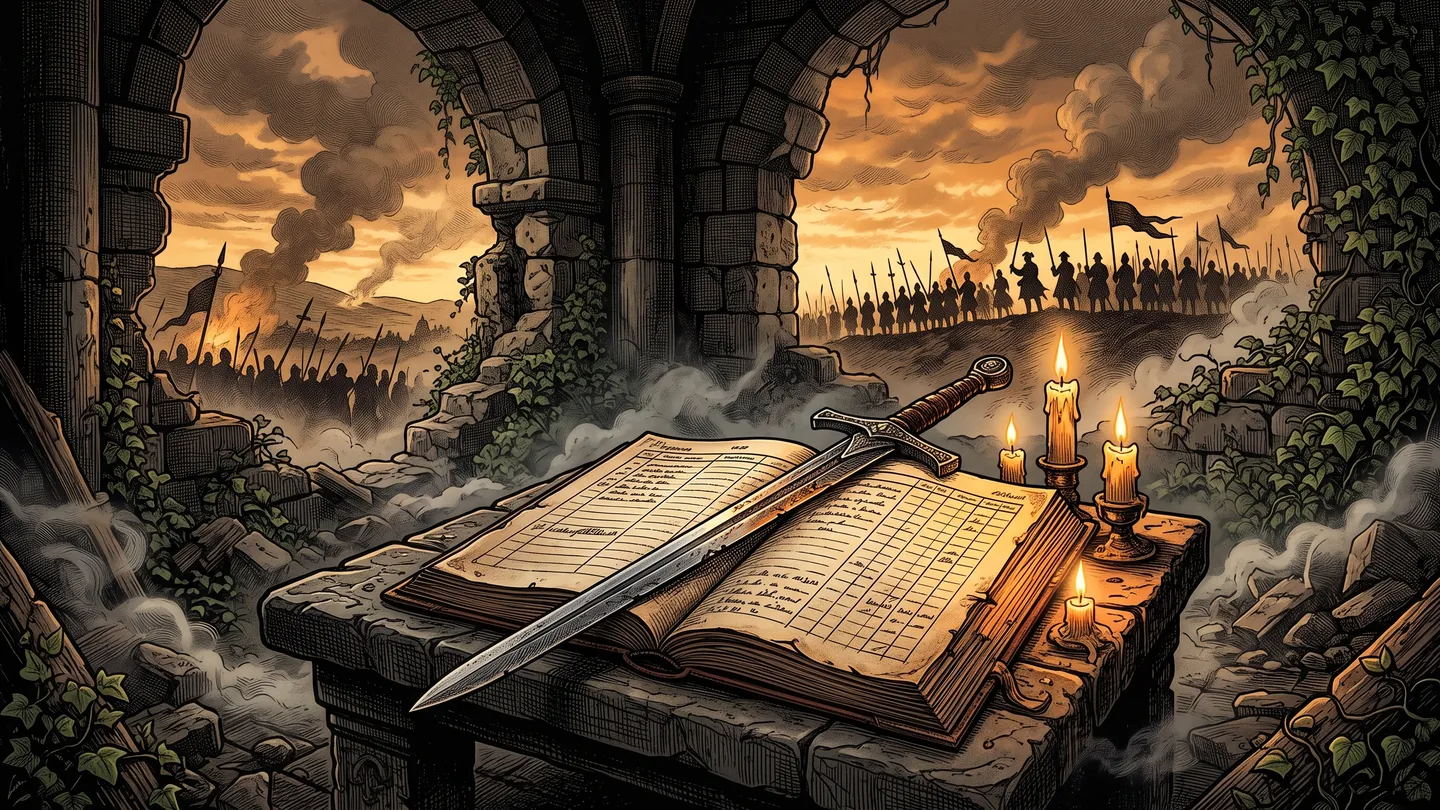
For as long as we have records of it, money has followed force.
Not force in the broad sense. Not the force of energy, or effort, or will. A narrower and cruder kind: the force of violence, and the threat of it. Whoever could inflict the most violence set the terms. Sometimes that was a single strong person. Sometimes an organized group. Sometimes whoever could build the better weapon. The scale changed. The principle did not. The one who could do the most harm decided who held value and who lost it.
This was not the best form of power, or the most sophisticated. It was the most obvious. It was the easiest to reach for and the easiest to grasp, which is exactly why it took hold.
You can see the same logic in the animal kingdom, where the larger animal eats first and the rest defer to the threat of its strength. You can see it among young children, where the one who can take a thing simply takes it. It is the first and most basic notion of power there is: if I can take it, it is mine.
As civilization has evolved, that same instinct has been dressed in more sophisticated clothing. Underneath the tailoring, it has rarely changed.
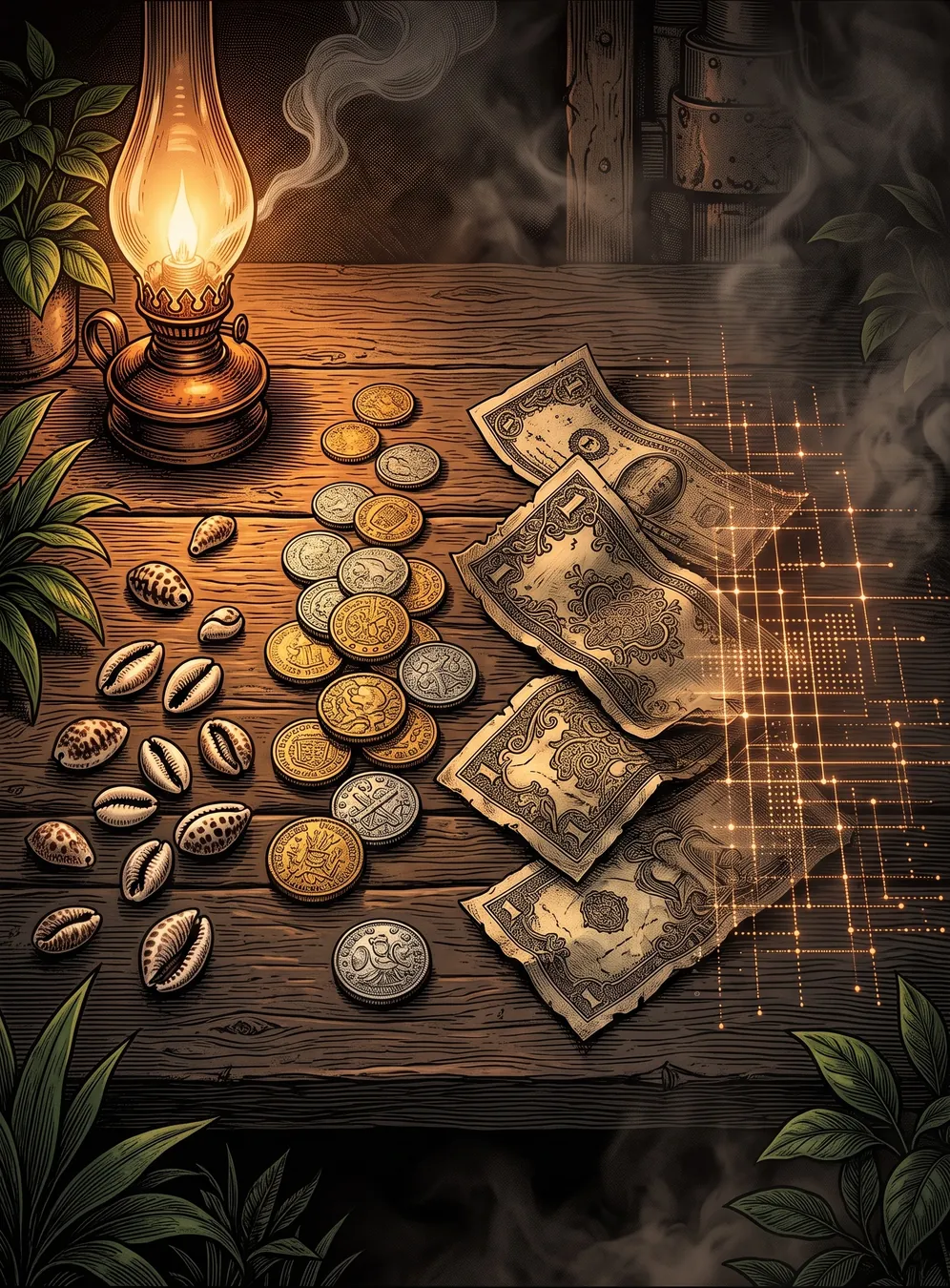
Money has taken many forms. In the earliest economies it was things like cowrie shells and beads, and later precious metals like gold and silver. Money is not the same as wealth. The wealth is in the assets: land, grain, timber. Money is what measures the value of those assets and lets that value move between hands. Whatever form money takes, control over it follows the same rule. Whoever can seize it, defend it, and enforce its acceptance sets the terms for everyone who uses it.
The forms kept changing. Metal coins became paper. Paper became digital, numbers on a screen moved by the swipe of a card, money most of us rarely hold in our hands anymore. Somewhere on that path the paper stopped standing for gold or silver and came to be backed by nothing but the authority of whoever issued it. Each step made money more abstract and easier to control from a distance. But beneath every form, the same pattern held. By the twentieth century it reached a scale no empire had ever achieved.
In 1944, with the Second World War ending, representatives of forty-four Allied nations gathered at Bretton Woods, New Hampshire. The United States was the one major industrial power not bombed into rubble by the war, and it held most of the world's gold. The mechanics of their agreement made the dollar function as the de facto world reserve currency. Every other currency would be pegged to the dollar. The dollar alone could be exchanged for gold, at a fixed rate of $35 per ounce. Every central bank would hold dollars as reserves. Every nation that wanted to trade internationally would need to acquire dollars first. The agreement presented itself as a stabilizing framework. What it actually did was move the might-makes-right principle from the battlefield to the balance sheet.
Demand for dollars became structurally ingrained in the global economy. The world needed dollars, and not by choice. Their supply was controlled by the Federal Reserve, a central bank that, despite its name, operates with substantial independence from democratic accountability. The supply of the world's de facto reserve currency was managed by an institution the world's population had no vote over, and it was ultimately backed by the most powerful military force in human history, and soon by the only nation on earth that held the atomic bomb.
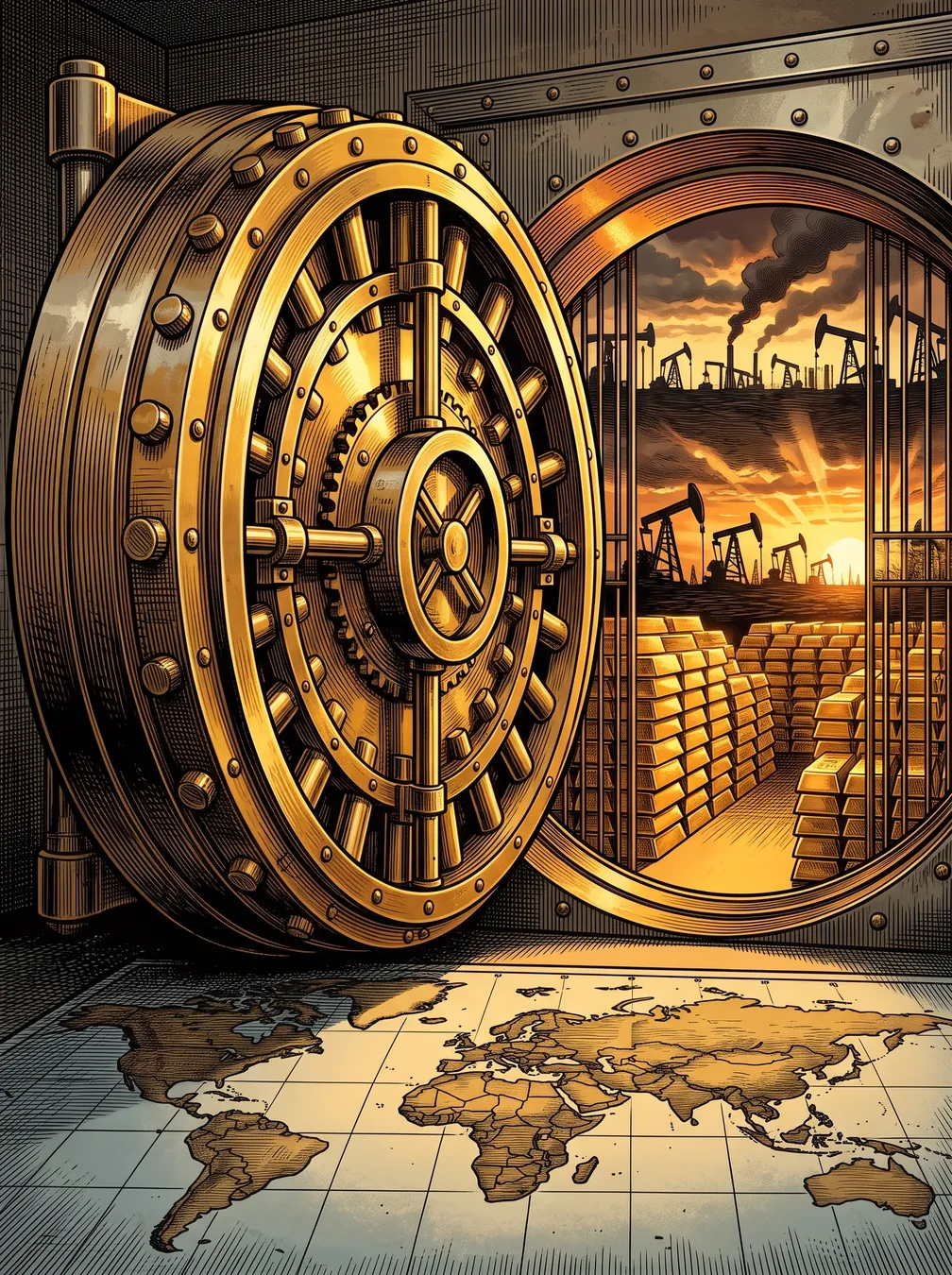
Under that Bretton Woods arrangement, foreign governments and central banks were promised they could always exchange their dollar reserves for gold at that fixed rate. In August 1971, President Nixon ended that promise. In what became known as the Nixon Shock, the United States unilaterally severed the dollar's convertibility to gold. Foreign nations holding dollars could no longer redeem them for anything except more dollars. The last external limit on how much the United States could print was gone. By 1974 and 1975, a new arrangement deepened the design further. The United States guaranteed Saudi Arabia's military security. In exchange, Saudi Arabia agreed to price all of its oil in dollars and recycle the proceeds through American banks. This became known as the petrodollar. Other oil-producing nations were brought into the same arrangement. From then on, to buy the energy that runs a modern economy, the world needed dollars. To get dollars, the world stayed inside the American system. A nation that tried to leave faced economic isolation from the global oil market, and behind that, the political and military weight of the United States.
There is a line often attributed to Mayer Amschel Rothschild, the eighteenth-century founder of what became one of the most powerful banking dynasties in European history, though historians have not been able to verify the source:
"Give me control of a nation's money supply, and I care not who makes its laws."
Whether or not he said it, the logic has been demonstrated at every scale. Military power and monetary power are not separate things. The money funds the military. It pays the soldiers, buys the weapons, builds the ships. Whoever controls the money can wield the violence, and the violence in turn protects the money. Each one guards the other. Now imagine that arrangement extended over the whole planet, where one nation's money is the money everyone else is required to hold. That is the world we live in.
Follow the money beneath the persistent problems of our time, and you arrive again and again at the same place. Picture a tree. The cruelty in how animals are raised and used. The grinding machinery of war. The poverty of nations whose soil holds more wealth than the nations that buy from them. These are branches. The monetary system that funds, subsidizes, and insulates all of them from consequence is the root they share.
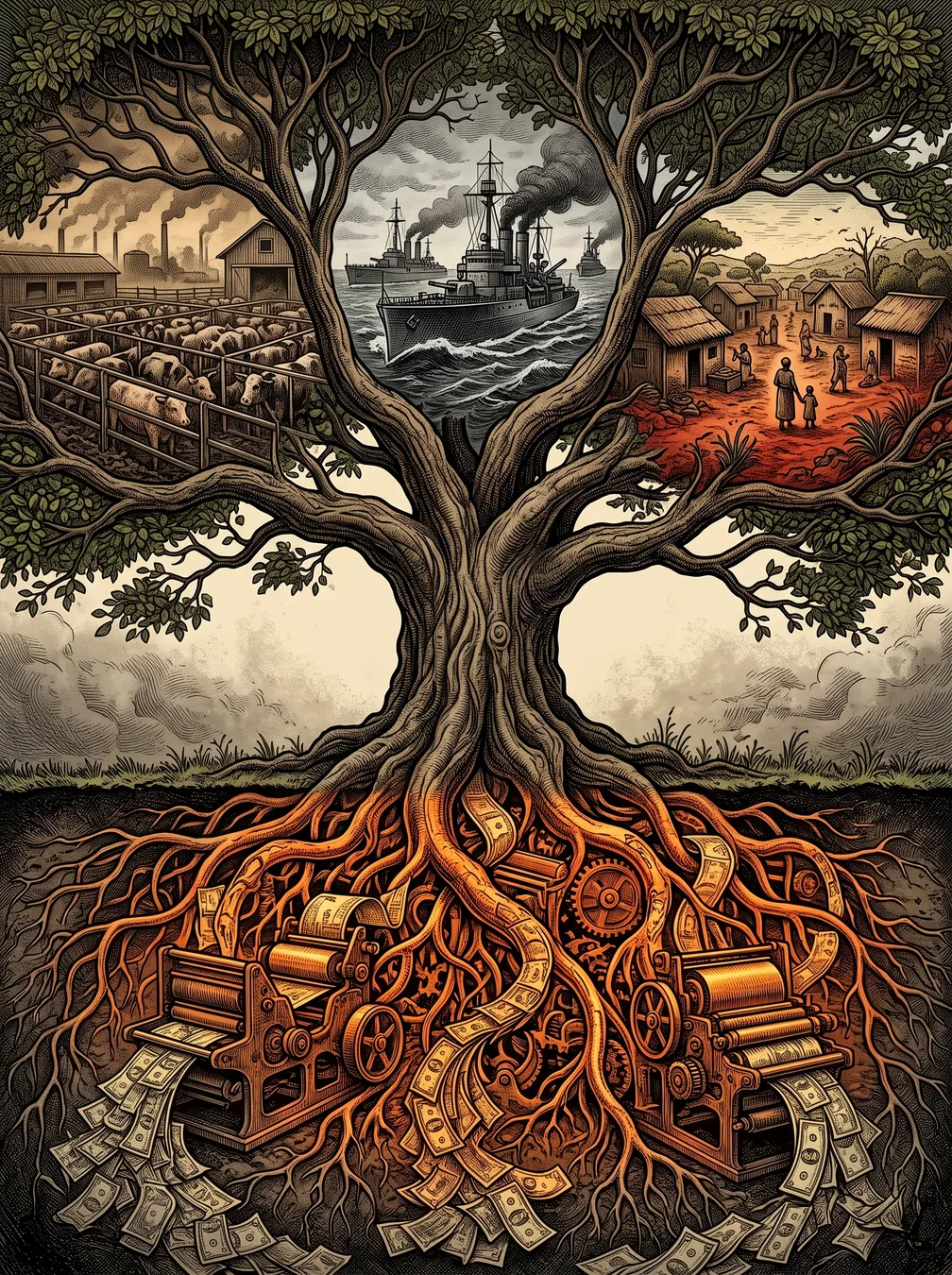
The factory farming of animals does not persist because it is efficient. Concentrated animal feeding operations and industrial dairies are wildly inefficient with land, water, and grain. They persist because a monetary system that can print without limit subsidizes their inefficiency invisibly. The cost is covered by printing more money, which spreads it to everyone through inflation. The true price never appears on the label. Endless war persists for the same reason. Fiat money removes the price of war from those who wage it. They print to fund the campaign, and the cost is distributed across every person holding the currency. And there is a third branch, the one this chapter is mostly about: the way whole nations are kept poor by money they were never allowed to control.
Anyone who has questioned how and why animals are exploited for human use, whether for food, clothing, or entertainment, is already using a particular moral compass. It is a refusal to accept injustice and oppression simply because they have been dressed up as normal. This chapter asks that the same compass be turned toward the money they earn and spend every day.
What changes with Bitcoin, and we will get there, is that for the first time money exists that does not run on coercive force at all. It runs on energy. Actual electricity consumed by a decentralized swarm of computers spread across the world, competing to secure the network. But it forces no one. No army stands behind it. No state can print it. No one can be compelled to accept it or punished for refusing it. The force that secures Bitcoin is the force of energy, not the force of violence. That single distinction is the whole of it.
That is not a technical distinction. It is a civilizational one.
But first, the wound.