Blood Money, Blood Food, and the Ascent
Two systems run on the same distance and the same euphemism. Naming them is the first step out.
Follow the freedom upward.
A single person who can hold money no authority can touch is free in one life. Multiply that person by a nation, and something larger gives way. A state's monetary power was never its own. It rested entirely on its people having no choice but to use its money. That was the whole foundation. Once they no longer have to, the floor is gone. A government cannot inflate savings it cannot reach. It cannot tax wealth it cannot see. It cannot pay soldiers in money they will not accept. The power to debase a currency means nothing when no one is forced to hold it.
Turn the old story over and the inversion is complete. A revolutionary once had to buy weapons in the colonizer's money, and pay soldiers in it, and so the fight against the system ran through the system. Now even the state cannot compel its own people through the money itself. The same lock that bound the citizen to the state binds the state to nothing once the citizen can walk away. The separation begins from below.
This separation has a precedent. For most of recorded history, across nearly every civilization, religion and worldly rule were fused. The throne that governed your body also claimed your soul, and to dissent from the official faith was not only sin but treason. The modern West gave the divorce a name, the separation of church and state, but the thing it names is older and wider than the phrase. Pulling the two apart did not abolish belief. It stripped the state of the power to punish you for it. You could believe, or not, and the ruler's lever on your conscience was gone. Money sits now where faith once sat. Fiat fuses identity, nation, and money into a single thing. The currency in your pocket carries the flag. Your worth is denominated in the state's unit. To hold value at all, you must hold what the state issues. That fusion hands rulers a power they were never meant to hold, the power to dilute a person's savings at will by printing more money. Separating money from the state takes that power away, the same way separating church from the state took away the power to punish belief. The ledger answers to no authority. No one can reach back and drain the value from what you have already earned.
This is where a quiet phrase finishes its meaning. Rules, not rulers. Not a kinder ruler. Not a fairer hand on the lever. No lever. When one party can print the money, you get extraction with a new face on it, the lever still corrupting the hand. When no one can print it, you get something the dark age has never allowed. Peace.
That word has to be earned, not asserted. So here is the mechanism beneath it.
Look at what the world saves in. Real estate. Gold. Oil. Government bonds. Each carries a premium above its use, a portion of its price that exists because people park their savings in it. And that premium has to be defended. A deed is worth something because an army and a court stand behind it. Gold is wanted everywhere, which is exactly why people with guns stand at the vault door, and why the paper claims that stand in for it are worth only as much as the force behind them. The monetary value of nearly everything we have ever saved in has been secured, in the end, by the threat of violence. The chain of custody is written in blood. We have simply stopped noticing it, the way we stop noticing anything that has always been there.
Bitcoin takes that premium and moves it. Not into another vault. Into physics and arithmetic. The ledger, a blockchain, is defended by energy, the electricity poured into the network of computers, and by math, the code no army can outflank. To seize it you cannot send soldiers. You would have to out-produce the energy of the entire network, and even then the rules turn your attack into a loss rather than a prize. A defense researcher at MIT named Jason Lowery put the whole paradigm shift in one line. "Not having to waste human life to defend monetized wealth is worth every watt." Fiat is secured by the force of violence. Bitcoin is secured by the force of energy, which kills no one to do its work.
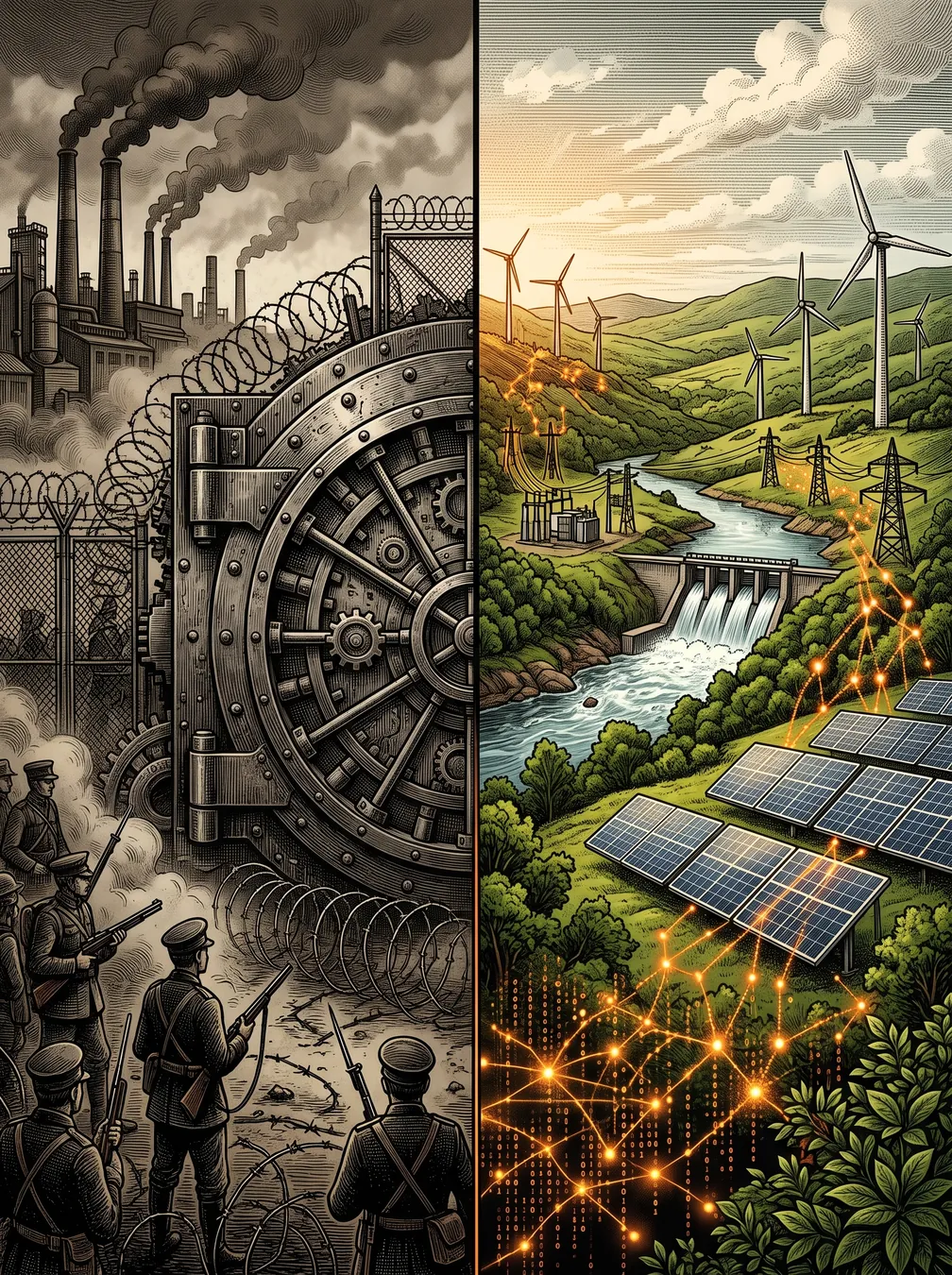
Follow what that removes. A money no army defends and no single authority controls cannot be weaponized by one party against another. No government can be frozen out of it to punish its people. No rival can be cut off from it and broken. No population can be inflated into poverty to fund a war it never agreed to wage. Enemies and allies hold the same money, and neither can turn it into a weapon against the other. A money no army can capture is a money no war can be fought to capture. This is how you make war unaffordable. You do not outlaw it. You remove the prize.
This is not a promise of a world without cruelty. Bitcoin is a tool, like a knife or a dollar, and a tool can be turned to wickedness by the wicked. What it removes is not the human capacity for harm. It is the systemic coercion built into fiat money, the lever that let the few extract from the many by force and call it order.
A money that runs on energy instead of violence is more than a better instrument. In one of the world's oldest accounts of how civilizations rise and fall, it is a rung on a ladder.
The Vedic tradition divides time into four great ages it calls yugas, a record of human consciousness rising and falling across vast cycles of time. They run from an age of darkness at the bottom to an age of light, peace, and abundance at the top. The wheel turns between them again and again, humanity climbing toward the light and sliding back toward the dark over spans longer than any history we record. In this framework, that turning is set by a companion star whose slow approach and retreat raises and lowers the energy reaching the earth, though you do not have to accept the astronomy to use the map. The lowest is the Kali Yuga, the age of matter. It is marked by ignorance, by greed, by violence. And it is marked, the texts say plainly, by two things in particular. War. And the eating of animals. The ages above it grow gentler and brighter, each one less coercive than the last, each one closer to peace. By most readings we have only lately begun to climb, out of the deepest dark and into an age of energy. The turn is slow, and the ages bleed into one another, but the direction has changed. A money that takes the blood out of wealth, arriving just as we begin to rise, is a rung this climb has not offered in a very long time.
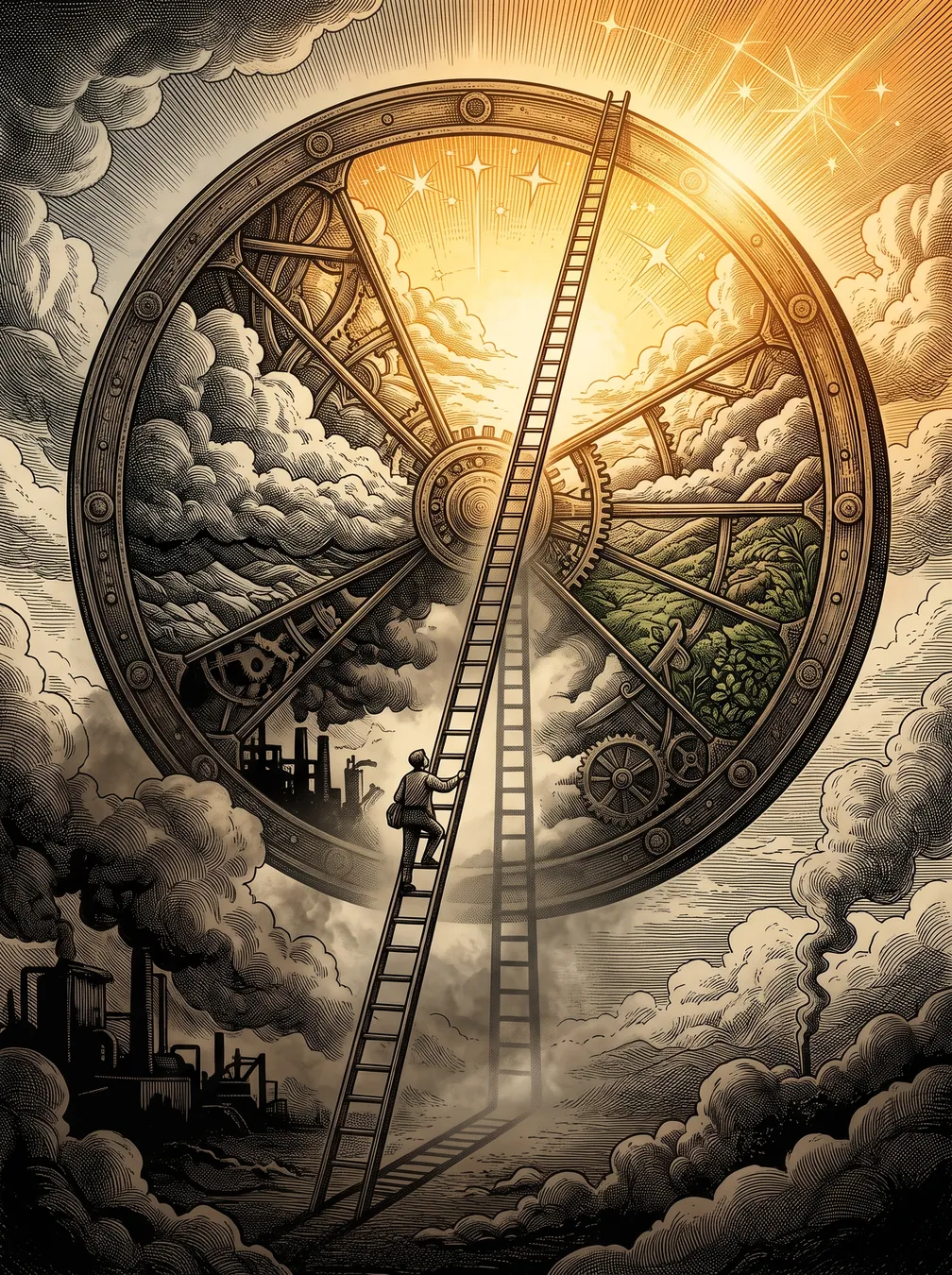
The same dark age that runs on blood-money runs on blood-food. One age, two deep cruelties. Both reduce a life to a thing, set its worth from the outside, and keep the arrangement with blood.
And once money belongs to no nation, identity need not tie to one either. A single money points, quietly, toward a single people on a single planet.
Two threads have run through all of this, the money and the food, and here is where they meet. Veganism removes blood from food. Bitcoin removes blood from money. Both are answers to oppression, one as it falls on animals, the other as it falls on people. They are the same refusal, aimed at two of the oldest systems of harm a civilization has ever normalized.
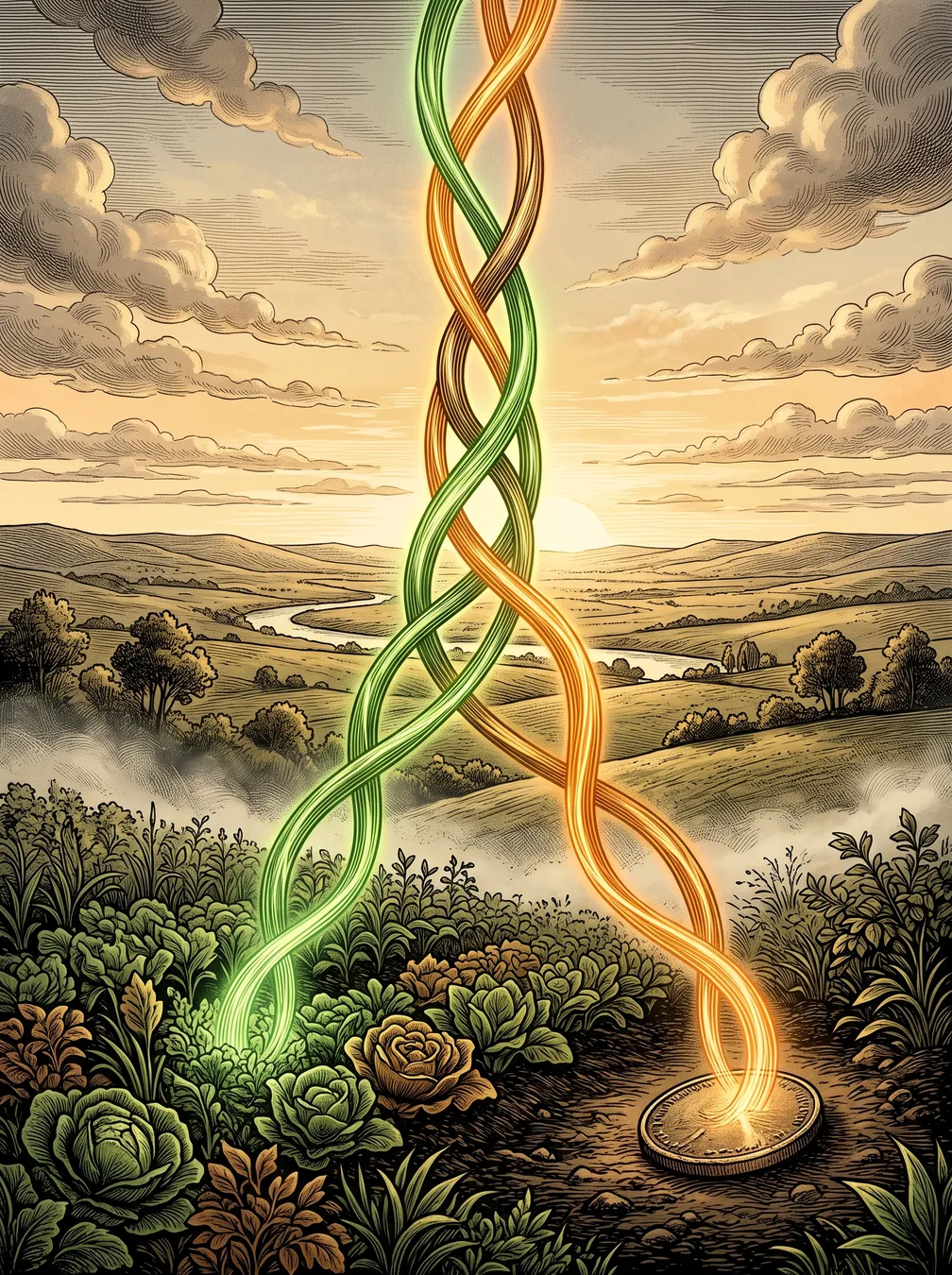
A civilization cannot ascend while it still runs on blood, whether the blood is in the slaughterhouse or in the ledger. To rise, it must leave both behind.
Someone who eats with conscience and still spends in fiat has not failed at anything. They have one foot out of the dark age already. The clarity that learned to see the animal behind the meat is the same clarity that can see the violence behind the money. The eyes that refused the one can refuse the other.